 Japanese
 English
Assembly is jointly performed by a robot and a human
A variety of robots are used at the device assembly stage, one of these being an AGV (Automated Guided Vehicle) that automatically moves components to the appropriate place without the need for human intervention.
An IC card is attached to all component containers, and when the number of components in a container starts running low and the container is removed from the shelf, the data from the IC card is transmitted to the inventory and an AGV brings fresh components. The AGV uses sensors to detect walls and people and is able to stop promptly even if a human suddenly appears in front of it. It also works out the shortest route to the delivery destination and moves efficiently around the plant. There are 11 AGVs in use here.
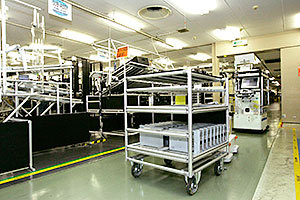
AGV (Automated Guided Vehicle)
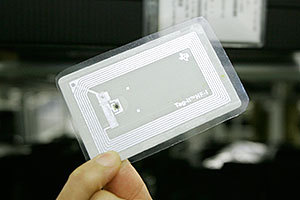
IC card that is attached to component containers
In this factory there is also a two-arm robot that exhibits an appearance and movements similar to a human. Designed by Hitachi from the wrist down, it is able to perform very intricate movements with its 15 joints and includes mechanisms developed in-house that are optimized for handling circuit boards. It has cameras for eyes, and is able to notice if it drops any component.
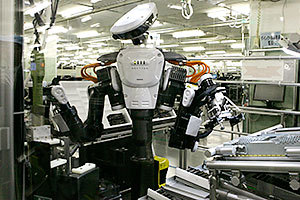
Two-arm robot
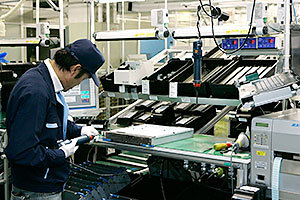
Humans and machines also work together to insert screws
However, not everything is left to the robots. In this plant workers and robots form pairs, and when a robot detects a defect, the worker deals with it swiftly to minimize the operation stoppage time.
While a worker inserts screws a machine counts the number of screws inserted and doesn't sound the work complete signal until the correct number of screws have been inserted, thus preventing any omissions.
Rigorous inspection that takes up around 90% of the manufacturing process
As mentioned at the start of this article, the product inspection period forms around 90% of Hitachi's manufacturing process, so it is not an overstatement to say that it is inspection that is at the core of the manufacturing process.
An ageing test in which products are subjected to an environment ranging from 5 to 40 degrees Celsius in temperature and voltage fluctuates is carried out over three days. The risk of failure is highest immediately after completion, so by deliberately placing the products in an extreme environment in this high risk period the risk of failure due to insufficient margins in semiconductor elements in the initial period after delivery to the customer can be reduced.
A heat run test is then performed on every single product (not on randomly selected ones) and simulates the conditions of a full installation to check the overall system. As the customer may wish to expand functionality and capacity after delivery, this test is performed under the assumed conditions of a future full implementation. Whether or not it performs according to commands from a server in a network environment is also checked at this stage.
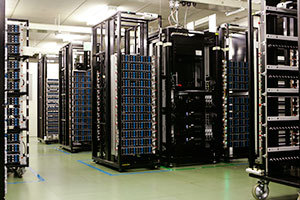
Heat run test
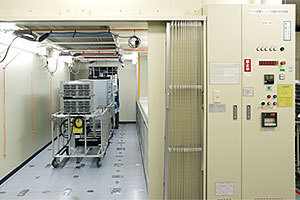
After passing these various tests, any options not included in the customer's configuration are excluded. Any components that are added as options are fully tested as all tests are performed under full operating conditions, so these components need just be attached as required. Further testing is performed after the system is configured according to the wishes of each individual customer before preparations for delivery are finally complete.
Incorporating such a high number of inspections into the hardware manufacturing process is the epitome of the Japanese "monozukuri" mindset as well as the Hitachi focus on quality. And it is from Odawara that Hitachi's high quality products continue to be shipped to destinations all over the world.
